Consulting and interim management
Enabling HR: working strategically instead of burning out on operations.
Beyond the single hire, I strengthen your HR and recruiting organisation so it sets the direction instead of drowning in day-to-day work. First clarify what matters. Then build.
Two advisory services to start. More to follow.
The living talent pool
A circle that co-develops, carries your brand, refers talent and fills your next role.
The only pool whose members work, instead of being managed. A curated, exclusive circle that takes on real questions from your company in a moderated iteration system: ideas, products, tests. Alive because work happens, not because messages go out.
On EU servers · Purpose-bound consent · Renewal and deletion automated
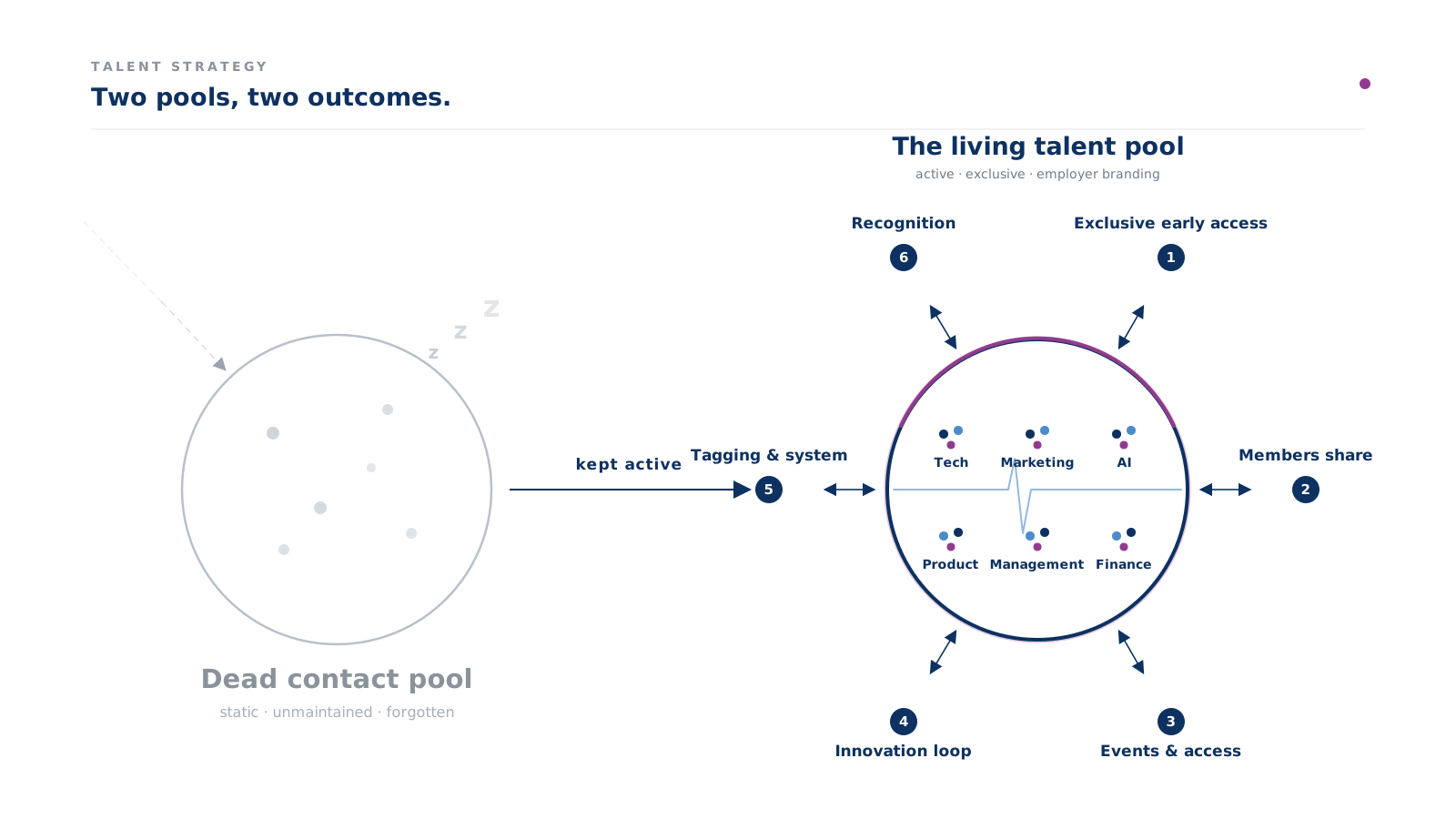
Almost every company keeps a talent pool. It is rarely used. Contacts are collected before it is clear what for, then the list just sits there until a role opens. By then the people have a new position or no memory of the first conversation. That is how a talent pool turns into a dead contact pool.
The living talent pool reverses the order. First the target picture, which activities and capabilities your strategy needs over the next 24 months. Then the pool, clustered exactly along them. So it holds the people you will need tomorrow, before the role is posted, and it stays in motion instead of ageing.
Three ways to handle talent
A database collected for later. No one tends it, it ages.
Tended and engaged, but members talk and give feedback. Nothing more happens.
The members work along: ideas, products, tests. Out of that come ambassadors, referrals and your next hire.
Six features define the living talent pool
A normal pool collects yesterday's candidates who did not fit, kept as a reserve for someday. That someday never comes, because the roles have changed by then. The living talent pool is built around the capabilities of tomorrow, not the rejections of yesterday.
The pool is not an open mailing list but a curated circle of experts you apply to join. What is scarce and exclusive gains value, and belonging binds. Whoever is in wants to stay in.
The larger part of the market, which is not actively looking, is reached by no advert, but by a personal recommendation, directly or through one's own network. By the trust studies it is the most credible form there is, ahead of any advert (Nielsen). The pool makes the recommendation the rule. (Industry estimate of the passive share: roughly two thirds to three quarters of the market.)
Members share what the pool gives them, because it is content worth sharing. Whoever contributes also brings their network along. So people carry your brand outward who are not on your payroll, an effect that employer branding from inside the company does not produce.
The company puts real questions into the pool and involves the minds in an iteration cycle. Existing innovation processes are rebuilt to use the pool, or new ones are built in which question and solution run through the pool's minds several times. Whoever helps build commits. Testers become co-developers.
The pool fills itself. Referrals turn into new members. The system reaches out to people who match tomorrow's capabilities and wins them for the circle. You maintain little, the pool grows.
How it works
We clarify which capabilities your next 24 months demand and cluster the pool along them. The workshop repeats at intervals.
We win the right minds and set up the platform, on GDPR-compliant servers.
We moderate the iterations, reach out to new members and keep the circle in motion.
Post roles to the pool first, invite to events, enter a new role and match it automatically.
Clusters by target picture
- Data & AI
- Product
- Sales DACH
- Engineering
Schematic view of the interface. Clusters by the capabilities of tomorrow, roles to the pool first, matching and referral in one.
Why members give their best, without a salary
No money flows, and that is right. Members come for proximity and for visibility. They are in the inner circle of a company that interests them, get insights that do not go public, and are closer to the next step there than any outside applicant. The second lever is yours: what comes out of the collaboration, you carry outward, in PR and your channels, and you name the members as co-authors. So every iteration builds the member's reputation, independent of any hire. Exactly this recurring return keeps the circle active. That matches the experience of co-creation communities: pay attracts at first, what remains is the experience of taking part and the recognition.
The pool you hire from first
The work shows what a CV cannot: how someone learns, how they communicate and reach a better result with others, even when that discards their own proposal. These are the capabilities that count once AI catches up with expertise. You see them over weeks of real collaboration, not in one interview. Bundle enough disciplines in the pool, and it becomes the first source you hire from, instead of searching every role anew on the market. Specialist positions stay the exception.
First the right people, then the strategy. Get the right people on board, and the way forward follows.after Jim Collins, "First Who, Then What", Good to Great (2001)
The groundwork we also deliver
So the pool is a solution, not just an idea.
- Platform with member interface, tagging and segmentation
- Integration with your ATS and HR system
- GDPR mechanics: consent, renewal, deletion, EU hosting
- Matching open roles to the pool, job posting with a head start
- Event management and reporting
The living talent pool complements your ATS, it does not replace it. It picks up where your system ends, at the relationship.
Frequently asked questions
How is this different from the talent pool in our ATS?
The pool in the ATS is a list that waits. The living talent pool works: members take on real tasks, stay in motion and qualify themselves along the way. You see people in action, not records.
Do we have the resources to run it?
We handle the build, the sourcing and the moderation. You work through the interface: enter a role, invite to an event, review the result. The ongoing effort on your side stays small.
What about GDPR?
The data sits on EU servers. Members give purpose-bound consent, the consent is renewed after the term, otherwise deleted. On request we delete within the legal period. The mechanics are built in, not your workload.
Does this replace our recruiting?
No, it shifts the focus. With enough disciplines in the pool, it becomes the first source you hire from. Specialist positions you keep searching on the market.
What happens in the diagnostic call?
We look at your next 24 months and the capabilities they demand, and check whether a living pool holds for you. You leave with a clear assessment, not with an offer you do not need.
Is your talent pool dead or alive?
Five questions, an honest read. No sign-up.
- Are the people in your pool clustered by the capabilities your next 24 months demand?
- Do your members take on real tasks from your company, instead of just receiving emails?
- Does the pool bring in new members on its own, through referrals?
- Do you know who is active right now and how well the collaboration runs?
- Have you hired someone from the pool in the last twelve months?
0 of 5 answered
Want to hire from a circle that already wants to work for you? In the diagnostic call we check whether a living pool holds for you.
From cost center to people operating system
Clear roles, clear ownership, decisions by metrics instead of gut feeling.
HR is often run as a cost center, administering processes. We develop HR into a people operating system: the system that steers capabilities, roles and decisions in the company, instead of working through tickets. Reactive processing becomes forward-looking design.
The result of cost-center thinking is the same everywhere: roles are filled the moment someone is missing, without knowing which capabilities the next two years demand. Responsibilities blur, processes live in people's heads, steering runs on gut feeling. HR chases the day-to-day instead of shaping it.
What a people operating system is made of
The Horizon workshop produces the picture of which capabilities your strategy demands over the next 24 months. It is the reference point for every role, every search, every development step.
Every key role is sharpened with Pre-Recruiting before it is posted. What the role has to deliver is settled before the first CV arrives.
Who decides, who delivers, who is heard. For every step in the recruiting and HR process the responsibility is named, not silently assumed.
The workflows no longer live in single heads, they are written down, repeatable and handover-ready. That holds even when someone leaves the team.
A few traceable metrics show where it sticks: time to fill, quality of the briefings, retention rate. Decisions run on data, not on gut feeling.
How it works
We look at your HR and recruiting processes, roles and metrics and name where it sticks today.
In the Horizon workshop we clarify the capabilities of the next 24 months as the reference point for everything that follows.
Roles, responsibilities and processes are sharpened and documented, the first metrics introduced.
We support the rollout, on request as interim leadership for a time, until the system holds without us.
What changes
Filled the moment someone is missing. Processes in heads, responsibility diffuse, steering by feeling. HR chases the day-to-day.
Roles before the search, clear ownership, documented processes, steering by metrics. HR sets the direction.
Frequently asked questions
Do we have to replace our HR team for this?
No. We build with the team that is there. The people operating system makes its work visible and steerable, it does not replace the people.
Isn't this just consulting with a new name?
The difference is the result. What remains are sharpened roles, named responsibilities, documented processes and a few metrics that stay, even when we are gone.
How does this connect to Pre-Recruiting and HIHB?
Pre-Recruiting is the core: clarify roles before you search. The people operating system turns that into the rule across the whole HR operation, not just in the single hire.
Do you also take this on interim?
Yes. On request we lead the function for a time, build the system in operation and hand it over once it holds without us.
Want to know where your HR organisation stands? In the diagnostic call we frame the first step.
Where does your HR organisation stand?
Fifteen minutes are enough for a first read on which of the two services fits your situation. Or why none does yet.