Horizon · From your strategy to the capabilities that carry it
„I know the future is coming. I just have too many options, too little time and too much else to do.“
You don't need another list of what the future demands. You need clarity on the few capabilities that decide your company's future. Before you need them and don't have them.
You decide once the goal, the path and the why are clear. For the skills that carry your future, none of that is clear today.
„My worry is not failing. It is perfecting the wrong thing.“
Three observations from conversations with management and HR leaders in the Mittelstand.
The diffuse noise
The division head talks about the 2025 worldview, HR about the 2023 pay scale, IT about a platform that ships in 2027. In between sits a strategy that needs people next quarter, and no one knows which.
Over-informed. Under-decided.
You are not uninformed, you are over-informed and under-decided. WEF, McKinsey, dozens of future competencies in five categories. Everyone is right, no one says what to do on Monday. Completeness does not help, it paralyses.
It is not on you.
What is missing is a method that turns the catalogue into a decision, in an order that makes sense. First the direction, then the few capabilities that matter to you. Only then build or buy.
„The day-to-day eats the future. A piece every day.“
Not another list. A decision.
One facilitated day. Three roles that otherwise never decide together.
Management, HR leadership and division heads sit at the same table, that is the condition, not the trimming. From your strategy we draw the five to eight capabilities that really carry it. Each in a sentence your team recognises on Monday: instead of „communication“ rather „can frame technical trade-offs so management decides in a single meeting“.
For each capability we show which profiles in your organisation reach it with a short upskilling path and which with a longer one. You see where you can build instead of having to buy. By the end of the workshop the build/buy decision is reasoned, not a gut feeling.
Four properties that carry together: a facilitated decision table, few capabilities instead of many, observable behaviour instead of definitions, a map from today's profile to the coming one. These four separate a skill strategy from a skill wishlist.
Three depth levels
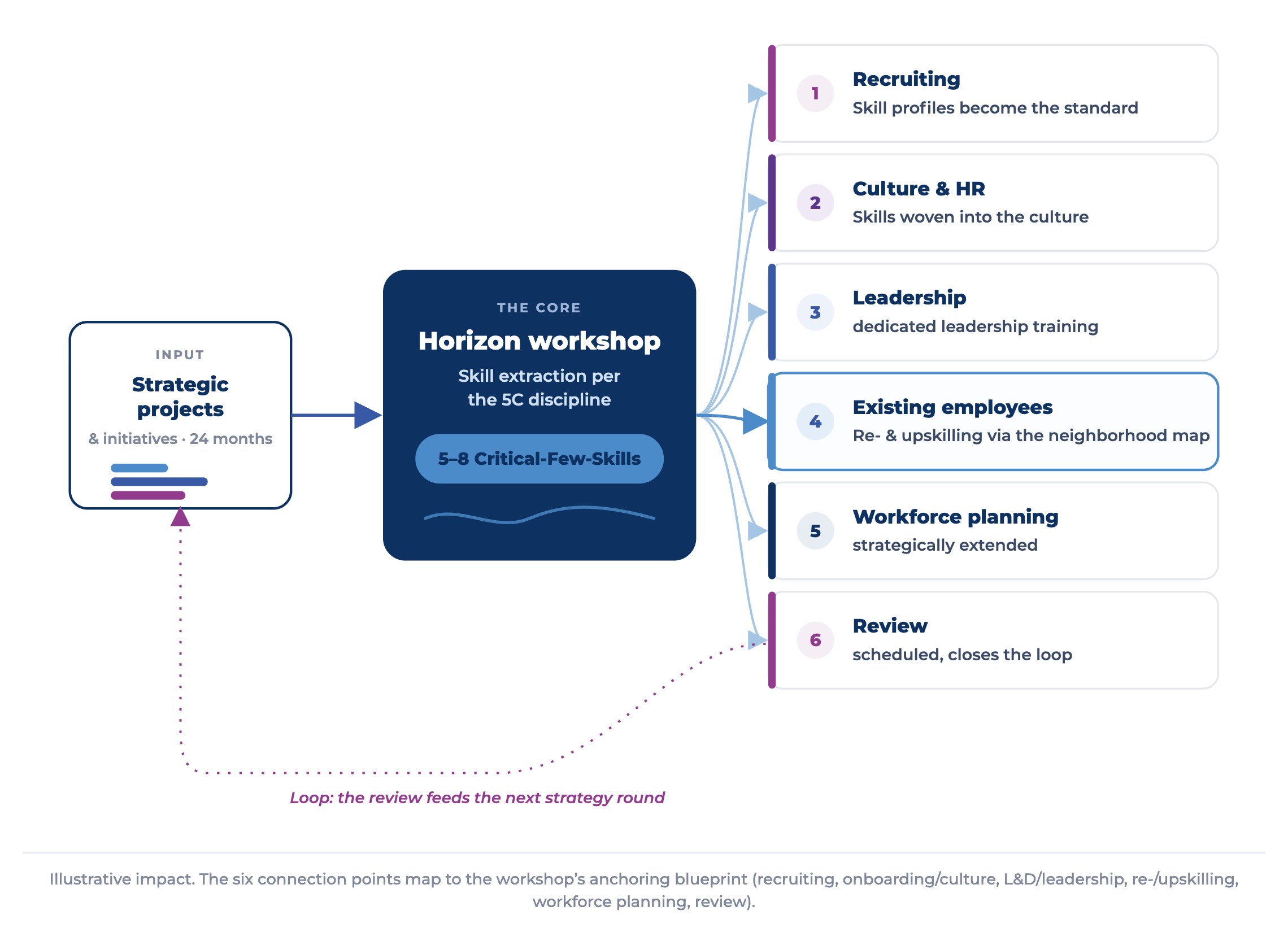
Strategy becomes lived people work.
One workshop, one clear set of skills, and they travel into every part of the organisation that deals with people. At the end, a review plans the next round.
„First the outcome. Then the activity. Then the capability.“
Five phases. One methodical discipline.
A systematic architecture that works out the core: which skills make our strategy succeed, and how do we anchor them in the company.
Strategy context before the workshop
A one-page pre-work brief to the participants: three-year goals, planned market moves, known bottlenecks. In parallel we deliver the market pack with industry skill trends.
Translate strategy into outcomes and key activities
For each strategic goal the question: which activities and capabilities decide whether we deliver? Impact scoring per candidate. A long list emerges.
From many to the critical 5–8
100-percent distribution: participants distribute the strategic leverage across the candidates. What falls below the threshold drops out. Conflicts between management, function and HR become visible and get resolved.
From the skill buzzword to observable activity
Each skill is worked through until it is observable and measurable, instead of „communication“ for example „can frame technical trade-offs so management decides in a single meeting“.
Gap, decision and skill neighbourhood
Current assessment per skill, gap heatmap. Build/buy/hire per skill with urgency. Plus the skill neighbourhood map with tier-1 and tier-2 profiles and upskilling time, the concrete anchor for people development in your organisation.
No PDF in a drawer
Per skill the connection points: recruiting profiles, onboarding, L&D curriculum, performance review. Plus first 90-day actions with an owner. Bridge to HIHB Accelerator: each hire skill becomes the template for a single-role workshop.
Six results. One of them no other provider delivers.
Each result is the precondition for the next, which is why the workshop builds them in exactly this order.
Critical-skills map
5–8 success-critical skills, prioritised. Per skill: behavioural anchor, target level, link to the strategic goal.
Skill gap heatmap
Target vs. actual per skill. Where the critical gap sits, position-precise and honest.
Build/buy/hire matrix
Per skill the decision: develop internally, buy externally or hire, with urgency.
Skill neighbourhood map
Per critical skill two rings: tier 1 (short upskill path, 6–12 months) and tier 2 (medium path, 12–18 months). HR sees at once which internal profiles fit the new roles.
Anchoring blueprint
Per skill the connection points: recruiting, onboarding, L&D, performance. Keeps the architecture from becoming a PDF in a drawer.
90-day activation plan
Concrete actions with named owners. What starts in Q1, with which budgets, with which review.
The map that makes your own team visible.
Example: you identify „Agile Coach“ as one of your critical-few skills. The map shows who in your organisation realistically gets there through upskilling, and in what time.
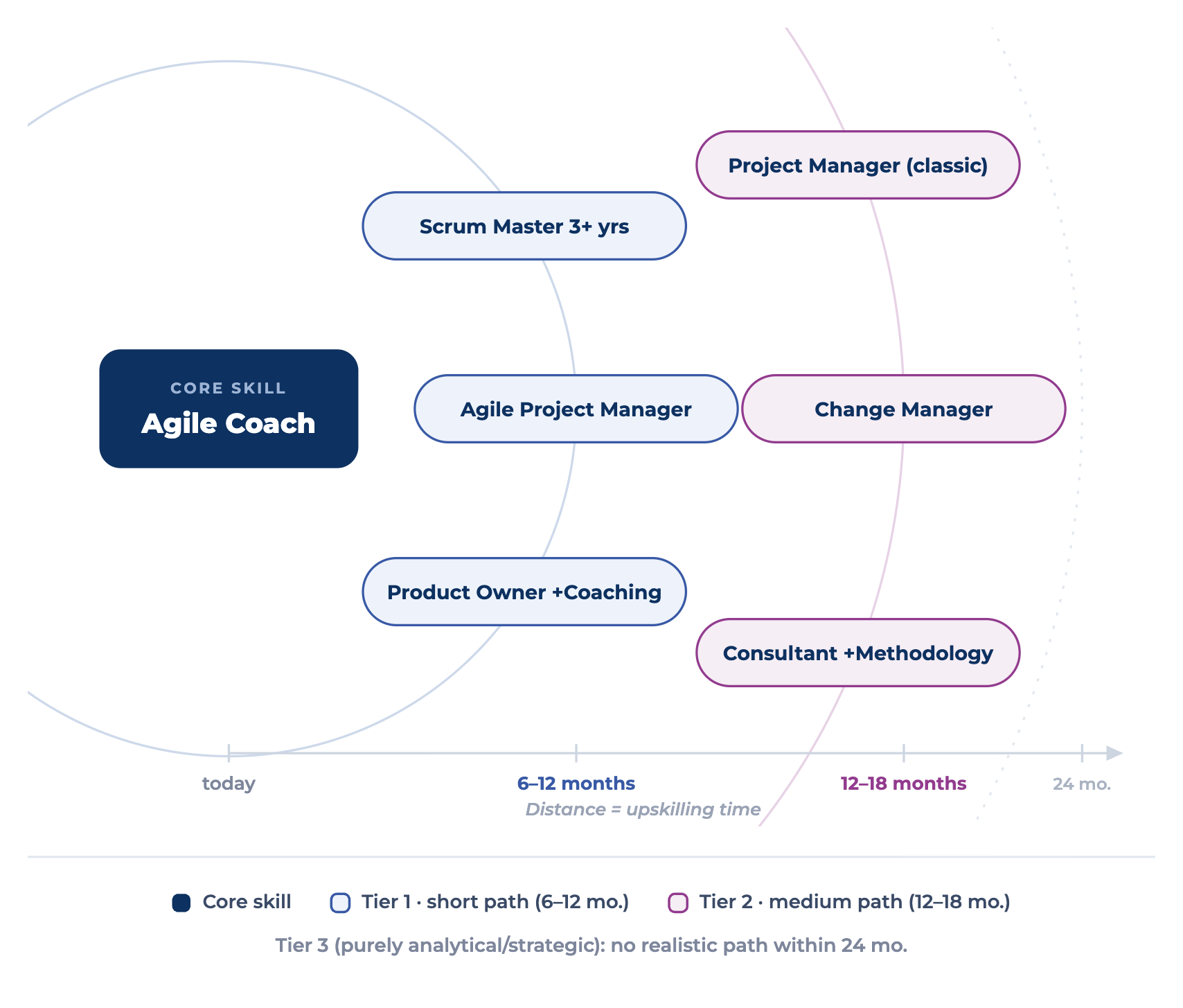
HIHB delivers the map. Your HR leadership does the person matching.
Your HR leadership sees at once: „We have twelve Scrum Masters in house. Of those, three to four are realistic upskilling candidates for the Agile Coach role in 6–12 months.“
And: „Our thirty classic project managers are two to three further candidates in 12–18 months. But the investment per head is higher.“
That turns the abstract build decision into a concrete movement hypothesis, without us ever touching personnel data. You keep data sovereignty, we deliver the method.
What Horizon does differently.
Three provider groups deliver skill strategy. Each with its own gap. Horizon sits in the gap.
| Dimension | Strategy firms | HR tools | Horizon |
|---|---|---|---|
| Timeframe | 6–12 months | software rollout 6–9 months | S 2–3h / M half day / L 2–3 half days |
| Number of skills | frameworks with 30+ skills | database with 800+ skills (AI-inferred) | 5–8 critical few, observable |
| Strategy anchor | yes, but abstract | no, only actual data | yes, management presents the strategy in phase 1 |
| Internal upskilling | generic talent maps | CV-based skill inference | skill neighbourhood map with tier-1/tier-2 rings |
| Hiring connection | not included | not included | anchoring blueprint + link to HIHB Accelerator |
FAQ
Why only 5–8 skills and not a complete taxonomy?
What is the skill neighbourhood map?
How do the three depth levels S/M/L differ?
Who has to take part in the workshop?
How does Horizon differ from HIHB Accelerator?
What company size is Horizon for?
What does a Horizon engagement cost?
Horizon translates your strategy into the few activities and capabilities that decide success or failure. A facilitated workshop in which management, HR leadership and division heads decide at the same table. Not another list. A decision.